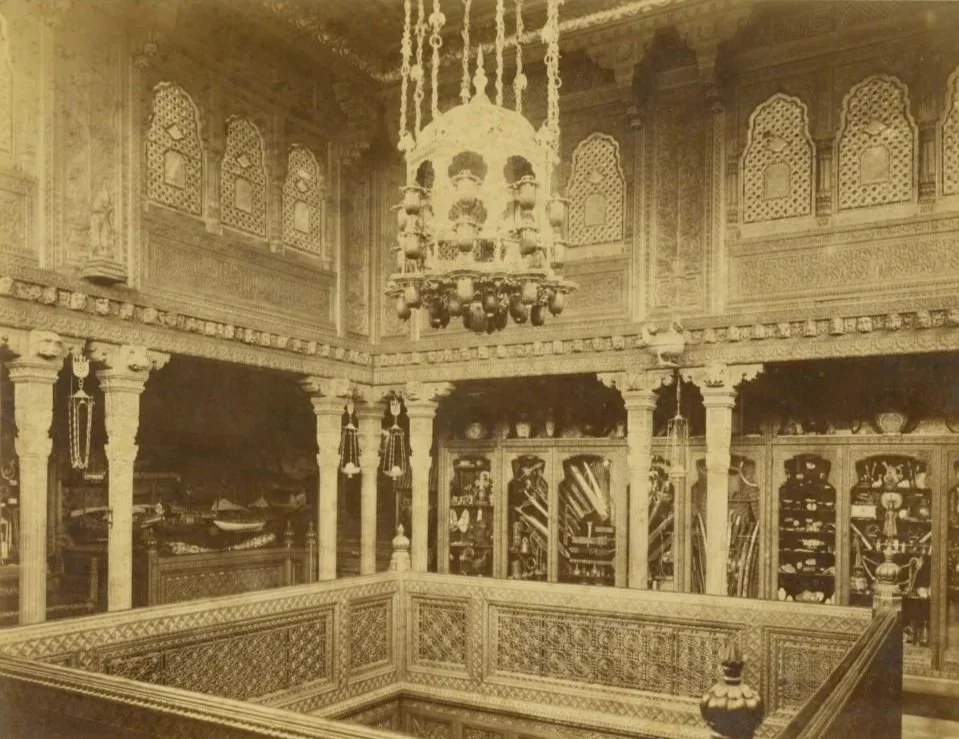
Upper Durbar Hall in the 1890s
Tracing the hands that built Durbar Hall
Playing the Race Card
When: Tuesday 10 November 2026
Time: 6.30-8.30pm
Where: Hastings Museum and Art Gallery, Hastings, East Sussex, TN34 1ET
Ticket Price: Free, reservation essential
Join us to discover the stories of the skilled craftsmen who built Durbar Hall.
Inside Hastings Museum and Art Gallery is a remarkable carved wooden room known as Durbar Hall. Originally created for the 1886 Colonial and Indian Exhibition in London, it was part of the Indian Court and was built in just nine months by two highly skilled artisans brought over from the Punjab.
The Brassey family bought and then gifted the Hall to Hastings Museum in 1919 and today it displays objects from their collection.
While the history of Durbar Hall has largely focused on the wealthy people who commissioned, owned and collected around it, much less is known about the South Asian craftsmen who created it.
What do we know about the people who made it?
Playing the Race Card, has been working with a group of local researchers of South Asian heritage to investigate the two highly skilled woodcarvers behind Durbar Hall - Mohammed Baksh and Mohammed Juma.
At this event inside the Durbar Hall the researchers will share what they’ve uncovered about the makers, the 1886 exhibition and the colonial history surrounding it. They’ll also be joined by V&A curator and photographic historian Sarah French, whose recent research into Annie Brassey and her collections has uncovered another part of the story.
Can you help with the research?
Do you have family knowledge, photographs, documents or connections that could help uncover more about the people who made Durbar Hall? Or would you like to get involved in the research and help uncover more? Come along on the night or email mail@playingtheracecard.com.
Tracing the hands that built Durbar Hall is a Playing the Race Card event co-produced with Home Live Art.
-
A gender neutral toilet is available and clearly marked.
The museum is set within its own grounds with free parking.
There is flat access throughout the building for wheelchair users and for people with limited mobility.
There are passenger lifts and an accessible toilet.
Please contact us if you have an questions or requests regarding access: deanne@homeliveart.com
-
Image: Photo from the Hastings Museum and Art Gallery website.